





















.jpg?la=en&h=320&w=720&hash=244C75B74F0F77521D56164450973BCD)














.jpg?la=en&h=310&w=720&hash=8D9823F26AA80B2B75C3E4B2E61770DC)


.jpg?la=en&h=320&w=719&hash=13CA7E4AA3E453809B6726B561F2F4DD)
.jpg?la=en&h=306&w=720&hash=F21A7CD3C49EFBF4D41F00691D09AEAC)

.png?la=en&h=320&w=720&hash=18CFCCD916C92D922F600511FABD775D)













Facial Recognition Locks: How Facial Recognition Works


First published in 2022, this article has been updated for 2026 to reflect the latest advancements in facial recognition technology, accuracy, and its role in modern access control systems.
Facial Recognition
Facial recognition technology, an innovative branch of biometric access control systems, has been making waves across multiple sectors. From unlocking smartphones with facial recognition locks to providing Biometric access control in high-security areas, it's becoming a cornerstone of modern security systems for commercial, industrial and institutional facilities. As organisations continue to prioritise both security and operational efficiency, facial recognition is emerging as one of the most effective and scalable solutions available today.
What Is Facial Recognition?
Facial recognition is an advanced biometric technology that identifies individuals by analysing unique patterns in their facial features. Unlike traditional security measures such as key cards or PIN codes, facial recognition relies on physiological characteristics unique to each person, making it significantly harder to replicate or compromise.
When used as an access control technology, facial recognition locks can revolutionise building security, offering a blend of cutting-edge accuracy and user-friendly accessibility to protect your facility. Whether you are managing a single-site office or a complex multi-building campus, facial recognition technology can be tailored to suit your security requirements.
How Facial Recognition Works
Facial recognition locks operate in a three-step process that grants access to registered employees and visitors while securing your building against unauthorised intruders.
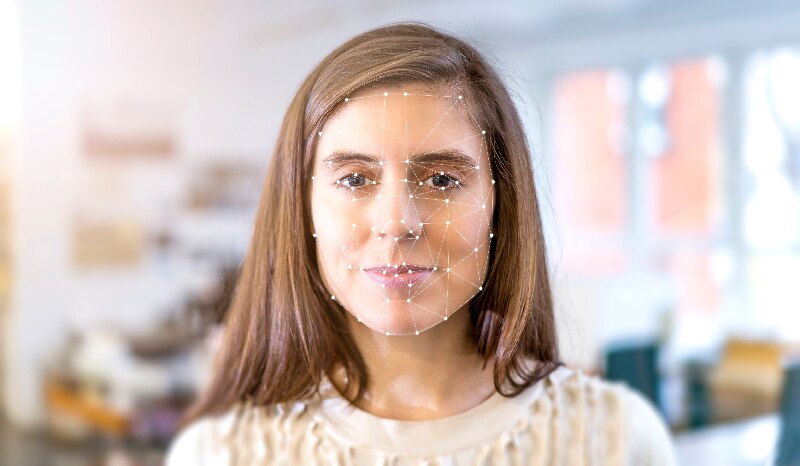
Using cameras at your building’s entrance and software in your central security system, a biometric reader will capture an image of an individual’s face in 3 stages:
- Detection - read the geometry of the individual’s face, assessing facial landmarks and the distance between features. This stage maps key reference points such as the distance between the eyes, the shape of the jawline, and the contour of the nose to create a precise facial map.
- Analysis - determine the unique ‘facial signature’ of the individual and compare this signature to the database of known faces registered on your building’s security system. This comparison uses sophisticated algorithms to calculate similarity scores, ensuring the process is both fast and reliable.
- Recognition - if the facial recognition lock can match the facial signature to an image in its database, the door will unlock and grant access. If the system can’t match the face to the database, access will be denied. The entire process typically completes in under a second, allowing for seamless, high-throughput access without bottlenecks.
How Accurate Is Facial Recognition?
While facial recognition accuracyis improving and usage is growing, there are still questions regarding its use. Critics often argue that inaccurate identification can occur, which makes a biometric access control system less effective than other security methods.
But the reality is that as technology continues to evolve, these facial recognition locks are now more precise than ever. The National Institute of Standards and Technology has reported that false identifications have dropped from 4.1% to 0.08% between 2014 and 2020. Error rates can change when facial recognition devices leave testing and enter the market, but this still represents a promising future for the industry.
Modern facial recognition systems are also increasingly capable of handling challenging real-world conditions, including variations in lighting, ageing, and partial obstructions such as glasses or face coverings, further improving their reliability in day-to-day security applications.
What Are The Benefits Of Using Facial Recognition?
If your building currently uses physical access control, and you’re thinking about upgrading to a biometric system like facial recognition locks, there are some benefits to consider:
- Streamlines access control: Removes the need for physical access items like keys, cards, or PINs, resulting in smoother traffic flow and reduced admin time replacing lost items. This also lowers long-term operational costs associated with issuing and managing credentials.
- Increased security: Facial recognition offers a more advanced level of security compared to traditional methods. Unauthorised access is minimised as potential intruders can't easily fake or replicate another person's facial features. Combined with multi-factor authentication, it can form a highly robust security layer for sensitive areas.
- Improved reputation: Investing in facial recognition positions your building as forward-thinking, potentially increasing value and appealing to prospective tenants or employees who prioritise security.
- Rapid intruder response: When an unauthorised face is detected, your facial recognition system can send alerts via your central security system with a clear image of the intruder, which can be stored for future identification. This enables security teams to respond swiftly and maintain a comprehensive audit trail of access events.
- Touchless, hygienic access: Facial recognition is entirely contact-free, making it a hygienic alternative to keypads or fingerprint scanners.
- Scalability and integration: Modern facial recognition systems can integrate seamlessly with existing access control infrastructure, allowing for phased upgrades without a complete system overhaul.
What Will Facial Recognition Look Like In The Future?
The journey of facial recognition technology doesn't end here. As it continues to evolve, privacy and regulatory issues will inevitably arise. But as this occurs, so will the diversification of biometric technology, allowing facilities to be more secure than ever before. Regulatory frameworks such as the UK GDPR place important obligations on organisations using biometric data, and responsible deployment will be key to building public trust in the technology.
Johnson Controls – At The Forefront Of Facial Recognition Technology
Johnson Controls aims to advance access control capabilities by developing its video surveillance solutions to create a comprehensive and accurate building security system. So, whether it's video analytics or thermal detection systems, the concepts used by facial recognition will see long-term success in the security sector. By combining facial recognition, intelligent video analytics, and thermal detection, facilities managers can build a layered, proactive security system that goes far beyond traditional security controls.
As the technology matures, we can also expect to see greater integration between facial recognition and wider building access control systems, creating unified platforms that offer real-time visibility and smarter threat detection.
Are you curious how facial recognition locks might fit into your building security system? Reach out to one of our security experts using the enquiry form below.