





















.jpg?la=en&h=320&w=720&hash=244C75B74F0F77521D56164450973BCD)














.jpg?la=en&h=310&w=720&hash=8D9823F26AA80B2B75C3E4B2E61770DC)


.jpg?la=en&h=320&w=719&hash=13CA7E4AA3E453809B6726B561F2F4DD)
.jpg?la=en&h=306&w=720&hash=F21A7CD3C49EFBF4D41F00691D09AEAC)

.png?la=en&h=320&w=720&hash=18CFCCD916C92D922F600511FABD775D)












What is a Smart Building? Technologies, Trends and the Business Case in 2026


Smart buildings use IoT sensors, automation and real-time data to optimise energy, operations and occupant experience. This guide explains the technology, the business case and what it means for UK facility managers and property owners.
Commercial buildings account for more than 30% of global energy consumption - and most of that is wasted through poor scheduling, equipment degradation and systems that operate without awareness of how the building is actually being used. Smart building technology changes this. By connecting building systems to IoT sensors, data platforms and intelligent automation, a smart building continuously learns and responds to real conditions, cutting energy costs, improving occupant comfort and giving facility managers far greater control and visibility than traditional static controls allow.
At the core of most smart buildings is a robust building automation and controls platform - the control layer that connects sensors and field devices to the interfaces and analytics tools that make a building intelligent. The global smart building market was valued at over USD 100 billion in 2024 and is forecast to grow at a compound annual growth rate above 11% through 2029, driven by rising energy costs, tightening regulatory requirements and growing demand from occupiers for high-performance, sustainable buildings.
What is a smart building?
The term emerged in the early 2000s alongside the spread of networked building infrastructure, and has since evolved with advances in IoT, artificial intelligence and machine learning. Today, a smart building is defined less by the hardware it contains and more by its ability to generate, analyse and act on building data - continuously and without manual intervention.
How do smart buildings work?
Smart buildings operate through a layered architecture connecting physical systems to digital intelligence.
Sensors and IoT devices
Sensors distributed throughout the building collect real-time data on temperature, humidity, occupancy, CO2 levels, air quality, energy consumption, lighting levels and equipment performance. IoT devices - physical hardware embedded with connectivity - transmit this data to central platforms over building networks.
Building management and automation systems
A building management system (BMS) provides the centralised control infrastructure that connects and coordinates these data streams. In a smart building, the BMS operates alongside - or is augmented by - automation and analytics platforms that move beyond simple control: adjusting HVAC, lighting and access based on real-time occupancy data, predicting equipment failures before they occur and generating the energy reporting needed for regulatory compliance. A building energy management system (BEMS) takes this a step further, focusing specifically on energy insight, fault detection and consumption optimisation.
Data, AI and analytics
The data collected by sensors is processed by analytics platforms - increasingly using machine learning algorithms - to identify patterns, predict outcomes and surface recommendations. AI-powered systems can learn a building's energy habits, model occupancy patterns and make autonomous adjustments that deliver ongoing efficiency improvements beyond what a static control schedule allows.
Core smart building technologies
| Technology | Role in a smart building |
|---|---|
| IoT sensors | Measure temperature, occupancy, air quality, energy and equipment status |
| Building management system (BMS) | Centralises control of HVAC, lighting, fire safety and security |
| Building automation systems (BAS) | Automates building operations using AI and data |
| Energy management platforms | Monitor energy consumption and support compliance reporting |
| Digital twins | Virtual models to simulate and optimise building performance |
| AI and machine learning | Predict failures, optimise scheduling and improve efficiency |
| Cybersecurity systems | Protect connected building infrastructure |
The business case for smart buildings in 2026
Energy cost reduction
Smart buildings can reduce energy consumption by 20-40% compared to conventionally managed buildings. Automated demand response - adjusting HVAC and lighting based on real-time occupancy rather than fixed schedules - eliminates the waste that accounts for a significant share of most commercial energy bills. For a large commercial building or estate, the savings are material from year one.
Occupant comfort and productivity
Research consistently links thermal comfort, air quality and lighting quality to occupant productivity and wellbeing. Smart buildings maintain optimal conditions continuously and can adapt to individual zone preferences - reducing comfort complaints and creating environments where people perform at their best. This is increasingly a competitive requirement for attracting and retaining occupiers.
Predictive maintenance and reduced downtime
IoT monitoring and AI analytics allow smart building platforms to detect equipment degradation early - flagging issues through trend data before they become failures. This shift from reactive to predictive maintenance reduces unplanned downtime, extends asset lifespans and lowers the total cost of building operations.
Sustainability, net zero and compliance
Operational emissions from buildings account for 28% of global energy-related carbon emissions. Smart building technology is one of the primary tools for addressing this at scale. For UK property owners working toward net zero carbon buildings, smart buildings provide the continuous measurement, automated optimisation and verified reporting that net zero commitments require. The data generated also supports MEES compliance, EPC improvement and ESG frameworks.
Asset value and occupier demand
Smart, energy-efficient buildings command a premium in the UK commercial property market. Investors and occupiers are increasingly requiring evidence of sustainability credentials and operational performance data as part of their decision-making. A building with verified smart technology and strong EPC ratings is more lettable, more valuable and better positioned against regulatory risk than an equivalent conventional building.
Smart buildings and the retrofit opportunity
Smart building technology is not limited to new developments. Much of the UK's commercial building stock is ageing - but retrofitting IoT sensors, upgrading BMS platforms and adding energy analytics layers to existing buildings can deliver comparable benefits to a new-build smart building specification. The Empire State Building in New York is perhaps the most cited retrofit example: a century-old skyscraper that reduced energy consumption by 38% through the introduction of a BMS and smart sensor network.
For UK property owners and facility management teams, the retrofit pathway is often the most immediate commercial opportunity - improving the performance of existing assets rather than waiting for new development cycles.
Frequently asked questions
What makes a building 'smart'?
A building is smart when it uses connected technology - typically IoT sensors, automation systems and data analytics platforms - to monitor and optimise its own performance in real time. The defining characteristic is the ability to act on data automatically: adjusting HVAC, lighting and energy systems based on actual conditions, not fixed schedules.
What is the difference between a smart building and a BMS?
A building management system (BMS) is the control layer that coordinates HVAC, lighting, fire safety and other building services. A smart building uses a BMS as its foundation but adds IoT sensor networks, data analytics, machine learning and energy management platforms on top - creating a system that can learn, predict and optimise rather than simply control.
Are smart buildings only for new builds?
No. Retrofitting IoT sensors, upgrading BMS platforms and adding energy analytics tools to existing buildings can deliver significant smart building benefits without a full new-build specification. Many organisations start with targeted improvements - energy monitoring, occupancy sensing or BMS upgrades - and build capability progressively.
How much do smart buildings cost?
Costs vary significantly by building size, existing infrastructure and the scope of technology deployed. New smart building specifications for large commercial developments may involve significant upfront investment, but typically deliver payback through energy savings, reduced maintenance costs and improved asset value within 3-7 years. Retrofit improvements can have shorter payback periods.
Johnson Controls: smart building technology for UK commercial buildings
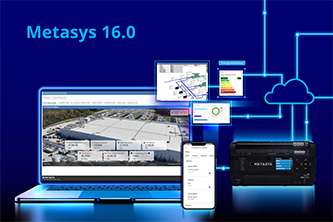
Johnson Controls delivers the building automation and controls infrastructure that underpins smart buildings across the UK and globally. Our OpenBlue platform and Metasys BMS give facility managers and property owners the real-time monitoring, intelligent automation and energy analytics needed to reduce energy consumption, improve occupant comfort and meet net zero and regulatory commitments.
Explore our smart building technology solutions, or explore our building automation and controls portfolio.