





















.jpg?la=en&h=320&w=720&hash=244C75B74F0F77521D56164450973BCD)














.jpg?la=en&h=310&w=720&hash=8D9823F26AA80B2B75C3E4B2E61770DC)


.jpg?la=en&h=320&w=719&hash=13CA7E4AA3E453809B6726B561F2F4DD)
.jpg?la=en&h=306&w=720&hash=F21A7CD3C49EFBF4D41F00691D09AEAC)

.png?la=en&h=320&w=720&hash=18CFCCD916C92D922F600511FABD775D)












Smart Building Technology in 2026: What Facility Managers Need to Know


The technology stack that makes a building smart has matured significantly. For UK facility managers, the question is no longer whether to adopt it - it is which technologies to prioritise, how to sequence investment and what measurable returns to expect.
Smart building technology is the integration of IoT sensors, automation systems and data analytics platforms with the building automation and controls infrastructure that manages a building's HVAC, lighting, security and energy systems - giving facility managers a building that monitors its own performance and responds automatically to changing conditions.
The smart building market has moved from early-adopter territory to mainstream infrastructure investment. Rising energy costs, tightening UK building regulations and growing occupier demands for sustainable workplaces have combined to make smart building technology a standard part of commercial property strategy. For facility management teams, understanding which technologies to prioritise and what returns to expect is now a core operational question. For a primer on the concept itself, see our guide to what is a smart building.
This guide covers the key technology categories that make up a smart building stack, how they work together, what each delivers for UK facility managers and the trends shaping investment decisions in 2026.
The smart building technology stack
Smart building technology is best understood as a layered stack, with each layer adding capability on top of the one below.
Layer 1: IoT sensors and field devices
Sensors are the data collection foundation of any smart building. Distributed throughout the building, they continuously measure temperature, humidity, occupancy, CO2 levels, air quality, light levels, energy consumption and equipment performance. IoT-connected field devices transmit this data in real time to central platforms. The quality and coverage of sensor placement is one of the most significant factors in determining how effectively the rest of the smart building stack can perform.
Environmental sensors that monitor air quality and CO2 concentration have become increasingly important - both for occupant wellbeing and for demonstrating WELL building standard compliance. Occupancy sensors that track where people are in a building at any given time feed directly into HVAC, lighting and access control automation, eliminating the energy waste of systems running in empty zones.
Layer 2: Building management and automation
The building management system (BMS) is the control layer that connects sensor data to building system responses. In a smart building, the BMS operates alongside building automation systems (BAS) that use real-time occupancy and environmental data to drive automated adjustments - modifying HVAC setpoints as occupancy changes, dimming lighting in response to daylight levels, controlling ventilation based on CO2 readings. The BMS controls layer is where static schedules give way to dynamic, data-driven operation
Layer 3: Energy management and analytics
A building energy management system (BEMS) adds a dedicated energy intelligence layer. Where a BMS controls building systems, a BEMS monitors energy consumption across those systems, identifies waste and inefficiency through fault detection, benchmarks performance against targets and generates the reporting needed for regulatory compliance and ESG frameworks. This is the layer that makes energy savings measurable and verifiable.
Layer 4: AI, machine learning and digital twins
The most advanced smart building platforms use artificial intelligence and machine learning algorithms to analyse historical and real-time data, identify patterns and make autonomous decisions. AI-powered predictive maintenance anticipates equipment failures from trend data before they occur. Machine learning optimises energy scheduling based on occupancy patterns, weather forecasts and utility pricing. Digital twins - virtual replicas of the physical building - allow facility managers to simulate changes, model performance improvements and plan interventions without disrupting live operations.
Layer 5: Security and access control
Smart buildings integrate physical security systems - access control, CCTV, intrusion detection - with the broader building management stack. IoT-connected access control systems link entry permissions to occupancy data, so heating and lighting only activate in spaces that authorised occupants have actually accessed. Smart sensors in privacy-sensitive areas provide safety coverage without cameras. The integration of physical and cybersecurity is increasingly critical: as buildings become more connected, the attack surface for cybersecurity threats expands, requiring robust network security and encrypted communications protocols.
What smart building technology delivers: measurable outcomes
- Energy cost reduction: Well-implemented smart building technology reduces energy consumption by 20-40% through occupancy-driven HVAC automation, intelligent lighting control and real-time demand management. For a large commercial building, this translates to material reductions in energy bills from year one.
- Improved occupant comfort and air quality: Continuous monitoring and automated adjustment of temperature, ventilation and air quality maintains consistent indoor conditions throughout the building. Occupancy-responsive zone control eliminates over-heating and over-cooling, while CO2-triggered ventilation keeps air quality at levels that support occupant productivity and wellbeing.
- Predictive maintenance and reduced downtime: AI analytics applied to equipment performance data flag degrading components before they fail. This shifts maintenance from reactive to predictive - reducing unplanned downtime, extending asset lifespans and lowering the total cost of building operations over time.
- Compliance and ESG reporting: Smart building platforms generate the verified consumption data and performance benchmarks required for MEES compliance, EPC improvement, energy audit documentation and ESG reporting frameworks. This is increasingly a requirement from institutional investors and large occupiers.
- Space utilisation insights: Occupancy data across zones, floors and meeting rooms gives facility managers clear visibility of how space is actually being used. This data supports decisions about capacity planning, desk management and lease strategy - particularly valuable for organisations managing hybrid working patterns.
How to approach smart building technology investment in 2026
Start with open standards
The single most important specification decision in smart building technology is insisting on open communication protocols - BACnet as a minimum, alongside Modbus for energy metering equipment. Open standards ensure that sensors, controllers and management platforms from different manufacturers can integrate and communicate without proprietary lock-in. This protects your investment as the technology stack evolves.
Audit your existing BMS before adding layers
Many UK commercial buildings have a BMS already installed but poorly configured or underutilised. Before investing in new IoT sensors or AI analytics platforms, establish what data your existing BMS infrastructure is already generating and whether it is being used effectively. In many cases, reconfiguring and optimising an existing BMS delivers significant energy savings before any additional technology investment is needed.
Prioritise high-impact technology first
Not every smart building technology has the same return on investment. Occupancy-based HVAC control, fault detection and energy sub-metering consistently deliver the highest impact relative to cost in commercial buildings. Start with these foundational capabilities before adding more advanced layers such as digital twins or AI optimisation platforms.
Build cybersecurity in from the start
As smart building networks expand - more devices, more cloud connectivity, more data flows - cybersecurity becomes a critical infrastructure requirement. Encrypted communications, multi-factor authentication for management interfaces and regular security audits should be built into the smart building specification from day one, not treated as a later addition.
Smart building technology trends to watch in 2026
| Trend | What it means for UK facility managers |
|---|---|
| AI-driven autonomous optimisation | BMS and BEMS platforms with embedded AI are moving beyond rule-based control to self-optimising systems that continuously improve efficiency without manual intervention. |
| Edge computing | Processing sensor data locally rather than routing everything to the cloud reduces latency, improves reliability and reduces cybersecurity exposure - particularly relevant for critical building systems. |
| 5G connectivity | Faster, more reliable wireless connectivity supports denser IoT sensor networks and real-time data transmission at scale across large or multi-building estates. |
| Digital twins at scale | Virtual building replicas are becoming a standard tool for performance modelling, maintenance planning and refurbishment scenario analysis - rather than a premium-only capability. |
| Regulatory pressure as a driver | MEES, BACS requirements and net zero commitments are accelerating smart building technology adoption for compliance reasons as much as operational ones. |
Johnson Controls: smart building technology for UK commercial buildings
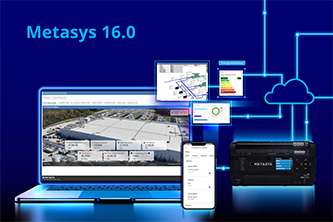
Johnson Controls delivers the building automation and controls platforms and smart building technology that UK facility managers and property owners rely on. Our OpenBlue platform and Metasys BMS provide the IoT sensor integration, intelligent automation, energy analytics and AI optimisation tools needed to reduce energy consumption, improve building performance and meet UK regulatory requirements.
Whether you are specifying smart building technology for a new development, upgrading legacy building controls or looking to get measurably more from your existing BMS, our team of building technology specialists can help. Download our Smart Building Transformation Guide for a practical framework covering technology selection, sequencing and ROI benchmarks for UK commercial buildings.
Explore our building automation and controls solutions or contact our team to discuss your building technology requirements.