





















.jpg?la=en&h=320&w=720&hash=244C75B74F0F77521D56164450973BCD)














.jpg?la=en&h=310&w=720&hash=8D9823F26AA80B2B75C3E4B2E61770DC)


.jpg?la=en&h=320&w=719&hash=13CA7E4AA3E453809B6726B561F2F4DD)
.jpg?la=en&h=306&w=720&hash=F21A7CD3C49EFBF4D41F00691D09AEAC)

.png?la=en&h=320&w=720&hash=18CFCCD916C92D922F600511FABD775D)












Building Energy Efficiency: 10 Practical Ways to Reduce Consumption Without Major CapEx


Most commercial buildings waste 20-30% of the energy they consume - and most of that can be recovered without significant capital investment. Here are 10 practical measures UK facility managers can implement now.
For facility management teams under pressure to reduce energy costs, improve EPC ratings and make measurable progress toward net zero carbon buildings targets, the first question is usually the same: what can we do before we have a capital budget? The answer is more than most people expect. The building automation and controls infrastructure already installed in your building contains the majority of the levers you need - it is a matter of how you are using it.
These 10 measures focus exclusively on operational and controls improvements - no major plant replacement, no major works, no planning permission required. The right starting point is always measurement, so we begin there.
1. Audit your BMS data before touching anything.
The single most valuable thing you can do is review what your existing building management system is already recording. BMS trend logs and alarm histories contain a precise record of setpoint drift, equipment running out of hours, sensors reading out of range and control loops hunting. A structured audit of trend data typically identifies 10-15 specific issues that are costing energy before any physical work begins.
2. Correct HVAC schedules to match actual occupancy.
Default HVAC schedules are set at commissioning and rarely reviewed. In most commercial buildings, heating and cooling run for two to four hours longer per day than they need to - starting too early, finishing too late and continuing through weekends and bank holidays regardless of occupation. Correcting schedules to match verified occupancy patterns via BMS controls typically reduces HVAC energy consumption by 8-15% with no capital spend and no impact on occupant comfort.
3. Implement optimum start/stop on HVAC plant.
Optimum start algorithms use current internal and external temperatures to calculate the latest possible start time for HVAC plant to reach setpoint by occupancy time. Most modern BMS platforms include optimum start capability that is either unused or poorly calibrated. Activating and calibrating optimum start on heating and cooling plant typically saves 5-10% on HVAC energy consumption by eliminating unnecessary pre-heat and pre-cool periods.
4. Review and correct temperature setpoints across all zones.
Setpoint drift is one of the most common and most invisible sources of energy waste in commercial buildings. Over time, setpoints are adjusted informally - often by facilities staff responding to comfort complaints - and never corrected. A systematic review of all zone setpoints against the original design intent, comfort standards (typically 20-22 degrees for heating, 23-25 degrees for cooling) and seasonal requirements typically identifies significant over-heating and over-cooling that can be corrected immediately.
5. Enable demand-controlled ventilation using CO2 sensors.
Most commercial HVAC systems deliver a fixed ventilation rate regardless of actual occupancy. Demand-controlled ventilation (DCV) uses CO2 sensors to modulate air supply based on actual occupant numbers, reducing the energy used to heat, cool and move air in spaces that are partially or fully unoccupied. Where CO2 sensors are already installed, enabling DCV through the BMS is a configuration change. Where sensors are absent, installing them is low-cost relative to the ongoing savings - typically reducing ventilation energy by 20-40%.
6. Identify and fix HVAC faults with fault detection.
A building energy management system with fault detection and diagnostics (FDD) capability can identify equipment issues that are silently wasting energy: stuck valves holding circuits open, control loops hunting rather than settling, bypasses that have opened and never closed. Each individual fault may appear minor, but collectively they account for a substantial share of energy waste in most commercial buildings. Buildings with active FDD typically identify 15-30% more equipment issues than those relying on reactive maintenance.
7. Switch to occupancy-triggered lighting in low-utilisation zones.
Meeting rooms, toilets, stairwells, storage areas and circulation spaces are routinely lit when empty. Activating occupancy-triggered switching in these zones via the BMS or through standalone sensor upgrades reduces lighting energy consumption in low-utilisation areas by 40-70%. This requires no structural work and minimal disruption - typically achievable as a planned maintenance task rather than a project.
8. Implement time-of-use energy management.
Half-hourly electricity metering data (available via your energy supplier or smart meter) reveals exactly when your building's peak consumption occurs. Shifting or reducing load during peak tariff periods - typically 4-7pm on weekdays - reduces both energy costs and carbon intensity, since grid electricity has higher carbon content during peak demand periods. BMS scheduling adjustments to reduce non-essential loads during peak tariff windows can reduce electricity costs by 5-12% with no impact on building operations.
9. Sub-meter high-consumption areas and equipment.
If you cannot measure it by system and zone, you cannot manage it. Installing sub-meters on HVAC plant, server rooms, catering equipment and other high-consumption areas gives you the granular energy data needed to identify anomalies, track the impact of improvements and support EPC reassessment or ESG reporting. Sub-metering is low-cost and straightforward to integrate with existing BMS infrastructure - and the insight it generates typically pays back the installation cost within months.
10. Conduct a formal energy audit and build a rolling improvement plan.
The nine measures above are actions you can implement immediately. The tenth is structural: commission a formal energy audit to establish a verified baseline energy use intensity (EUI) figure, identify the full opportunity map and build a rolling improvement programme with quarterly targets. An ESOS-qualifying audit provides this framework for large organisations. For smaller portfolios, a basic audit aligned to the UKGBC framework gives you the consumption baseline and reduction pathway needed to demonstrate progress toward net zero - and to make a credible case for EPC rating improvement.
What these 10 measures deliver
| Measure | Typical energy saving | CapEx required |
|---|---|---|
| 1. BMS data audit | 10-15% reduction in identified waste | Zero - uses existing data |
| 2. Correct HVAC schedules | 8-15% HVAC energy reduction | Zero - BMS configuration only |
| 3. Optimum start/stop | 5-10% HVAC energy reduction | Zero if BMS capable; sensor calibration only |
| 4. Correct setpoints | 3-8% HVAC energy reduction | Zero - BMS configuration only |
| 5. Demand-controlled ventilation | 20-40% ventilation energy reduction | Low - CO2 sensors if not installed |
| 6. Fault detection activation | 10-20% equipment efficiency improvement | Low if BEMS layer needed; zero if already deployed |
| 7. Occupancy-triggered lighting | 40-70% lighting energy in target zones | Low - sensors and BMS programming |
| 8. Time-of-use load management | 5-12% electricity cost reduction | Zero - scheduling and procurement |
| 9. Sub-metering | Visibility only - drives all other savings | Low - meters and BMS integration |
| 10. Formal energy audit | Unlocks further 10-20% through structured programme | Low - professional fees |
Implemented together, these 10 measures typically deliver 20-30% reduction in total building energy consumption before any capital investment in new plant, fabric improvement or renewable energy. That is the equivalent of one to two EPC rating improvements - and the foundation for a credible net zero reduction pathway.
Johnson Controls: building automation that makes energy efficiency measurable
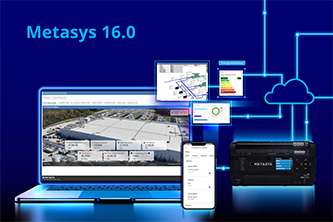
Johnson Controls' Metasys platform and building automation and controls solutions give UK facility managers the BMS data, fault detection and energy analytics tools needed to identify and capture the efficiency opportunities in their buildings - without waiting for capital programmes. Our building energy management and smart building technology capabilities provide the monitoring, controls optimisation and verified reporting that turn these 10 measures from a checklist into a managed, measurable improvement programme.
Explore our building automation and controls solutions.